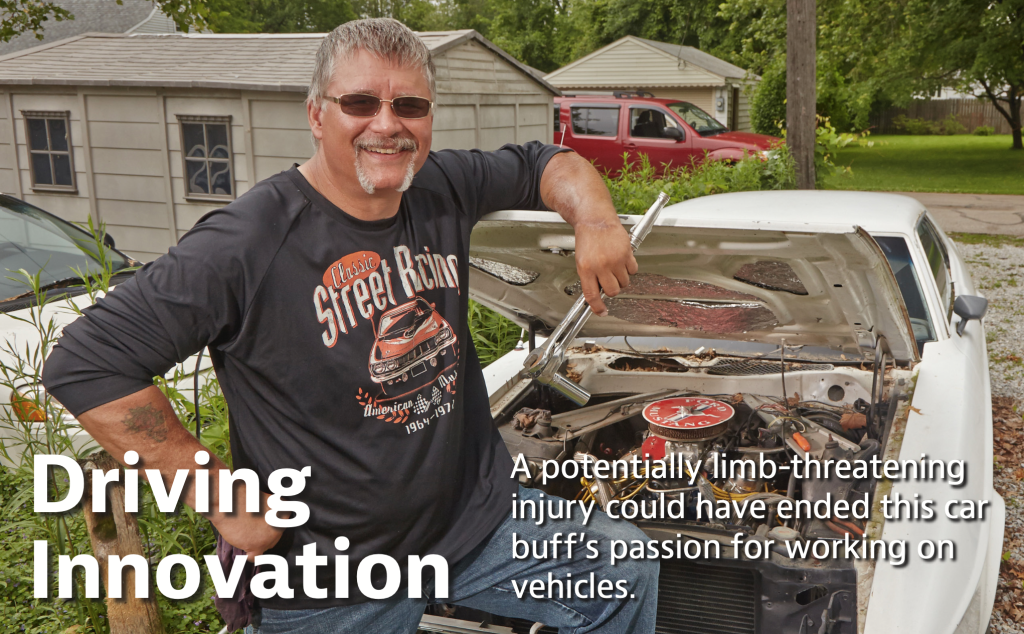
A potentially limb-threatening injury could have ended this car buff’s passion for working on vehicles.
Eight minutes doesn’t seem like a long time—unless your arm is trapped between two giant metal rolling pins—then, it turns agonizing: “I could feel the muscle in my arm boiling from the heat. The rubber was 275 degrees. If I would have hesitated 2 or 3 seconds more, I probably would’ve lost my arm.”
Joel Decoskey had been working his shift at a rubber mill in 2007 when his glove suddenly stuck to the sticky material, pulling his left arm into the machine and toward the crushing metal and quickly-melting rubber.
Joel’s swift thinking prompted him to hit the safety button, which stopped the machine, while other mill workers came running, extricating him from the heat and pressure of the machine.
“Joel had a severe, limb-threatening injury that required reconstructive plastic surgery and an infection that we could solve with IV antibiotics,” explained Dr. Vanek.
Joel’s arm was badly burned and crushed, resulting in exposed tendons and third-degree burns progressing to tissue loss all the way to the bone. Dr. Vanek began a series of limb-saving procedures, which included tissue expansion, skin grafting and nerve releases.
“I was kind of shaky at first – I was never the kind of guy to go to a doctor to take care of a cold. But Dr. Vanek is fantastic. He’s got an excellent bedside manner. He really takes care of his people. The staff is fantastic, real polite. They help you out any way they can. If I have something that Dr. Vanek can take care of, I’m going to him.” Over the years, Joel’s scarring, grafts and crush injuries gave him difficulty with flexibility and range of motion and neurologic pain. Despite excellent participation with hand therapy, he still had severe symptoms.
The recent innovation of autologous fat grafting was offered to Joel by Dr. Vanek, who performed this cutting-edge biotechnology procedure at TriPoint Medical Center in Concord. In Joel’s case, fat cells harvested from his stomach were placed into his arm scars, under his skin grafts and around the nerves that were injured.
Before the surgery, I wasn’t able to hold onto a wrench very long. My hand would feel fatigued very fast. Since that procedure, I’ve been able to get back to working on cars.
– Joel Decoskey
“We process fat in real-time and know that it contains stem cells from our own tissues that are available in peripheral fat through tissue harvesting,” explains Dr. Vanek. “It stimulates regenerating tissue, so it’s the ultimate in bioengineering.”
Stem cells found in fat act as chameleons, blending with the surrounding area: “Where the skin graft meets the natural tissue, the stem cells set up shop and essentially make the skin more elastic; it makes it more like natural tissue.”
Scarred and burned tissues respond to fat grafting techniques to make them more supple and mobile.
A groundbreaking technique
This remarkable procedure is useful not only for burn injuries but for a wide range of patients. “Patients who have restricted movement from burned tissue, radiation or breast reconstruction can be greatly improved by this procedure,” says Dr. Vanek. He has performed similar procedures on patients with breast cancer, Achilles tendon wounds, diabetic wounds and sites of previous surgery that are uncomfortable.
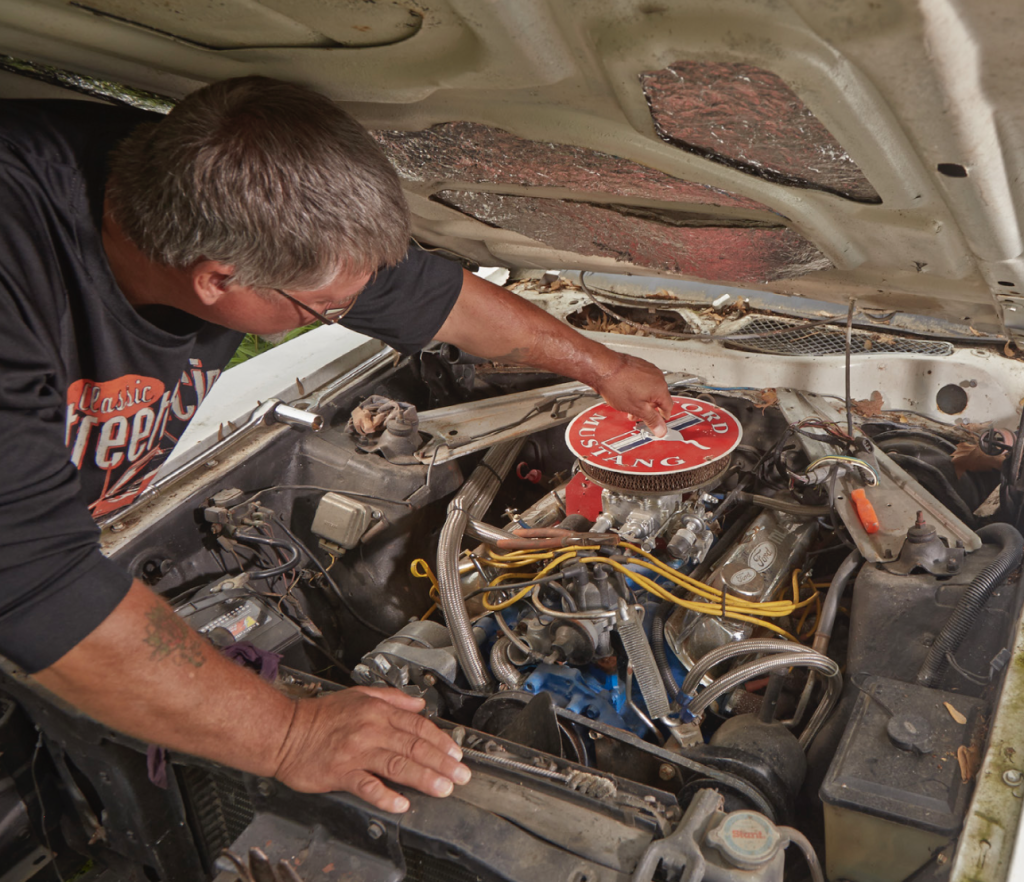
Joel’s surgery was successful, with his final autologous fat graft giving him relief from his scarring, nerve entrapment and restricted mobility. Just five days after the surgery, Joel could bend his wrist 90 degrees. Today, he is back to his favorite hobby: working on cars. “Before the surgery, I wasn’t able to hold onto a wrench very long. My hand would feel fatigued very fast. Since that procedure, I’ve been able to get back to working on cars.”
Dr. Vanek says, “That’s the goal of reconstruction—to get people back to doing what they want to do and not be restricted by their injury or illness. We want to get people back to their lives.”
You should know:
- If you think you are a candidate for reconstructive surgery, a board-certified plastic surgeon will help you review the options, risks and outcomes.
- You don’t have to stay overnight in the hospital for autologous fat grafting; you can go home the same day. You might need more than one fat graft to see desired results.
- After surgery, physical therapy and lifestyle changes will help ensure a speedy recovery.
More about the doctor
Paul Vanek, MD, FACS
Board certified in general surgery and plastic surgery
Office: Mentor Medical Campus
Originally published in Best of Health, Lake Health, Summer 2015.